What Is a Metronome
What is a metronome? A steady click at a speed you set, so you can hear whether you are in time. Below: the meaning, how it works, the tempo words from Largo to Presto, and how to practice with one.
A metronome is a device that makes a regular click, tick or flash at an adjustable speed, counted in beats per minute (BPM), so a musician can keep a steady tempo while practicing, playing with others or recording.
The word joins the Greek metron, measure, and nomos, rule: a ruler for time.
Metronome meaning, and where the word comes from
In everyday speech a metronome is the ticking box on top of a piano. In music the word covers anything that does that job: a pendulum, a digital unit, a phone app, or the click in recording software.
The device dates from the early 1800s. Dietrich Nikolaus Winkel, in Amsterdam, found that a pendulum weighted on both sides of its pivot could swing slowly while staying small. Johann Nepomuk Maelzel added a scale of speeds and patented it in 1815, which is why scores write M.M., for Maelzel’s Metronome. Beethoven was among the first composers to add metronome numbers.
The idea has not changed: one even pulse that does not speed up when the music gets exciting or slow down when it gets hard.
What is a metronome used for?
Five jobs, from the practice room to the studio.
- Practicing an instrument
- The click shows where the beat really is, so rushing and dragging become audible.
- Learning a hard passage
- Play it slowly enough to get every note right, then raise the speed in small steps.
- Recording
- A click track in the headphones keeps every take at one tempo, so parts line up.
- Playing together
- A band or choir agrees on a tempo before the count in.
- Reading a score
- Set the number printed above the music to hear the speed the composer meant.
Drummers and producers often swap the bare click for a groove: you can program a drum beat in your browser at the same BPM and practice over that instead.
Hear the click at 60, 90 and 120 BPM
Each example has four beats to a bar, with beat one a little higher so you can hear where the bar starts.
60 BPM
One click a second, about a resting heartbeat. Larghetto.
90 BPM
Three clicks every two seconds, an easy walk. Andante.
120 BPM
Two clicks a second, a brisk march. Moderato to allegro.
The clicks were made for this page with a simple synthesized tone; nothing was recorded.
How a metronome works: pendulum or digital
A mechanical metronome is a clock movement driving an upside down pendulum. A digital one counts time electronically.
On a pendulum model a rod with a sliding weight sticks up out of the case. Each swing releases the wound spring by one notch, which makes the tick. The scale behind the rod usually runs from about 40 to 208 beats per minute.
Mechanical and digital metronomes compared
Power
Mechanical. A spring you wind with a key
Digital. A battery, the mains, or the phone it runs on
How it keeps time
Mechanical. An upside down pendulum; a sliding weight sets the speed
Digital. An electronic clock counts the gap between clicks
Setting the tempo
Mechanical. Slide the weight; up is slower, down is faster
Digital. Buttons, a dial or a slider
Accented first beat
Mechanical. Some models ring a bell on beat one
Digital. Usually, for any number of beats in a bar
What you sense
Mechanical. A wooden tick and a swinging arm
Digital. A click, often with a light
Where it slips
Mechanical. Uneven on a tilted surface; slows as the spring runs down
Digital. Steady unless the device is overloaded
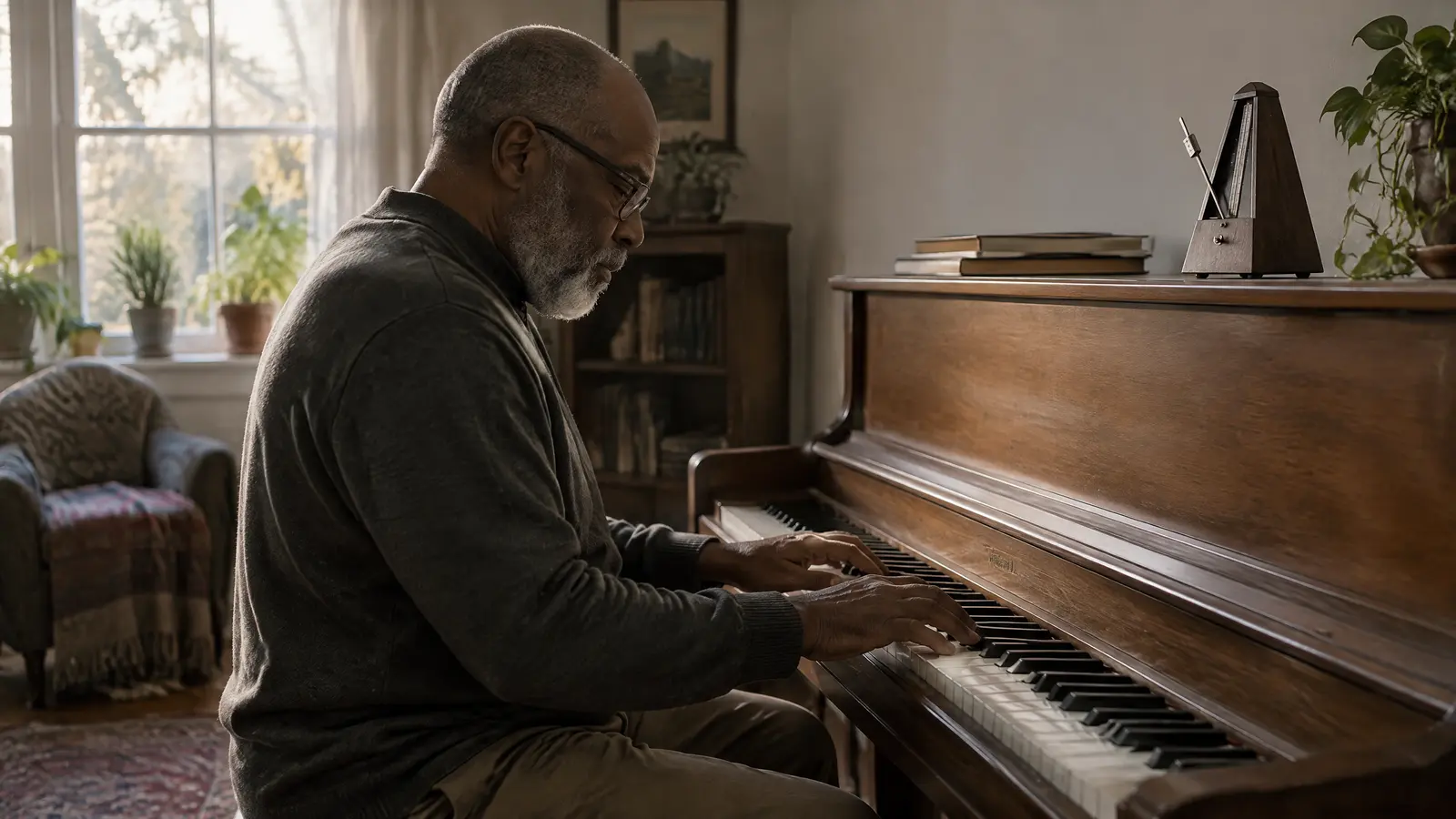
Tempo markings from Largo to Presto, with BPM
The Italian words describe character as much as speed, so the ranges overlap and sources differ by a few beats. Treat them as a starting point.
| Marking | Meaning | About (BPM) |
|---|---|---|
| Grave | Very slow, solemn | 25 to 45 |
| Largo | Broad, slow | 40 to 60 |
| Larghetto | A little less slow than largo | 60 to 66 |
| Adagio | Slow, at ease | 66 to 76 |
| Andante | At a walking pace | 76 to 108 |
| Moderato | Moderate | 108 to 120 |
| Allegretto | Fairly quick, lighter than allegro | 100 to 128 |
| Allegro | Quick, bright | 120 to 156 |
| Vivace | Lively | 156 to 176 |
| Presto | Very fast | 168 to 200 |
| Prestissimo | As fast as possible | above 200 |
Small words change the marking: molto means very, poco a little, ma non troppo not too much.
Practicing with a metronome, step by step
The routine teachers give for any passage that is too fast for you today.
1.Find the speed you can play cleanly
Start well below the target, where every note is right and your hands stay relaxed. For a fast passage that is often half speed.
2.Listen to a full bar first
Let the metronome click for a bar, count it in under your breath, and come in on the accented beat one.
3.Play it right three times in a row
Three clean runs at one tempo means you own it. One lucky run does not count.
4.Raise the tempo by a small step
Two to four BPM at a time is enough. Big jumps bring back the mistakes you just removed.
5.When it falls apart, step back
Return to the last clean tempo, play it twice more, and stop. Tomorrow start a few BPM lower.
6.Then take the click away
Play the passage once without the metronome and record it. Any rushing or dragging shows up on the recording.
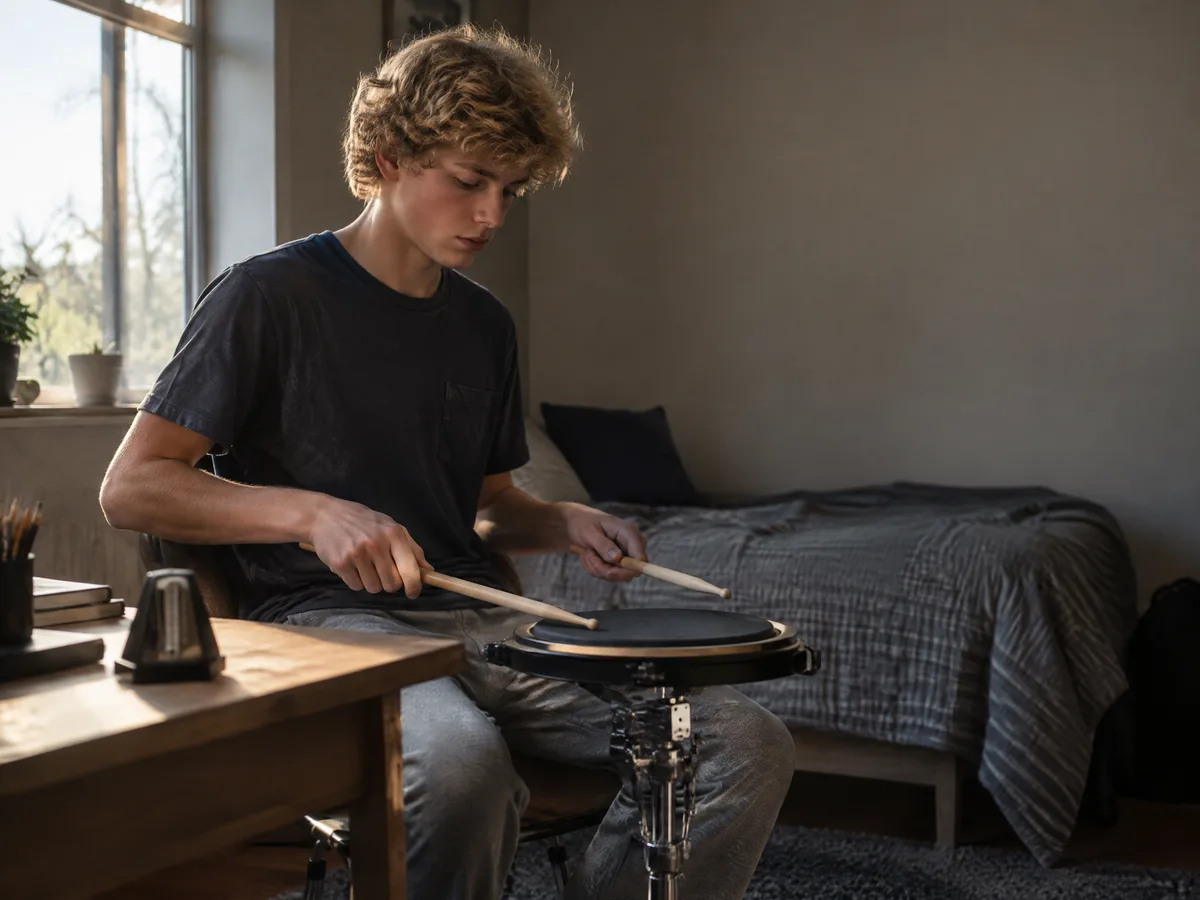
Slow enough to play it right
Start where every note comes out clean, even if it feels too easy, and move up a few BPM at a time.
A jazz tip: set the metronome to half the tempo and hear each click as beats 2 and 4. Keeping beat one is then your job.
1.Set the tempo and the beats per bar
Drag the slider near your number, then press minus or plus to move one BPM at a time. Under it, pick how many beats make a bar: 3 here, for a waltz.
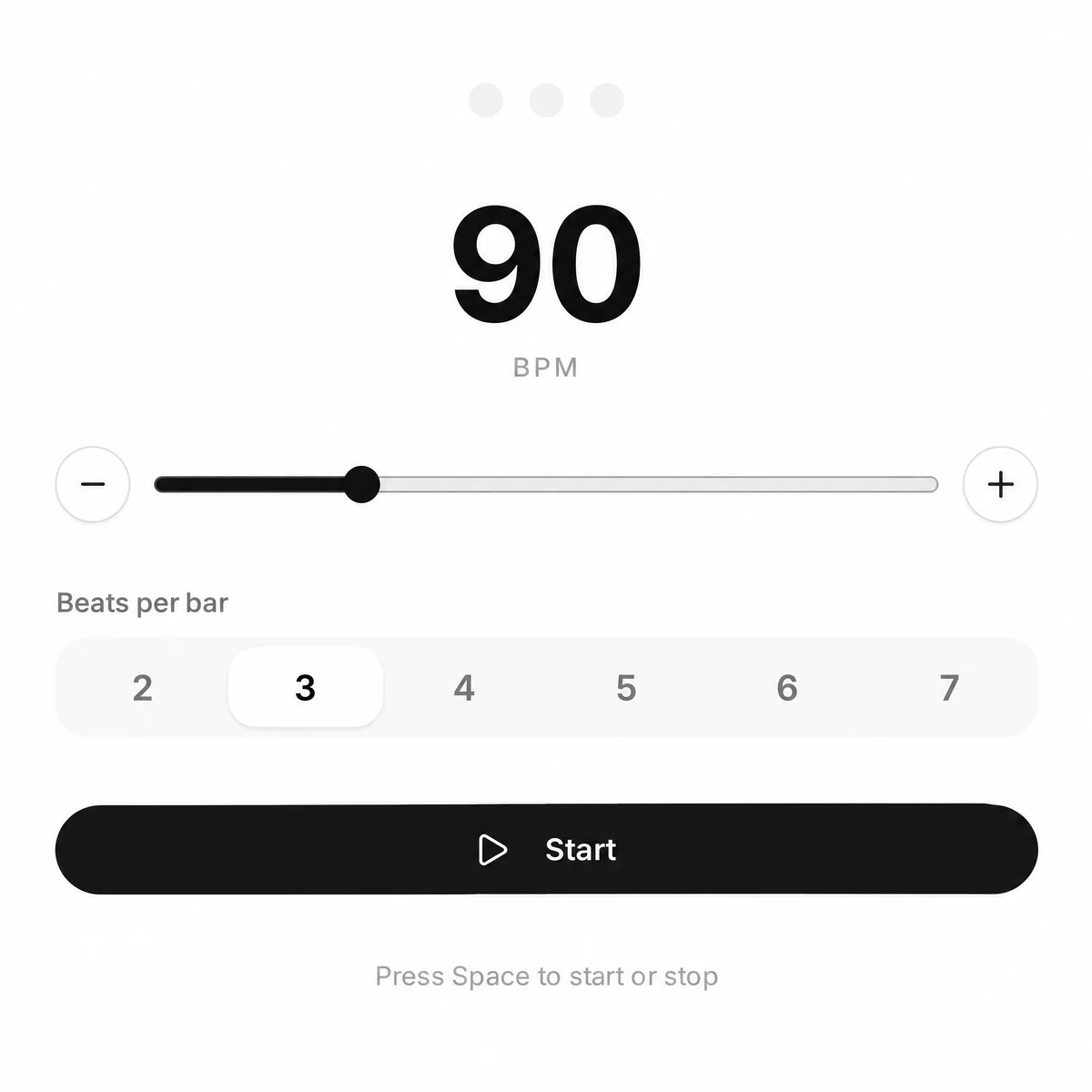
2.Press Start or the Space bar
Beat one clicks higher than the rest and the dots light up on each beat. Press Stop or Space again to end.
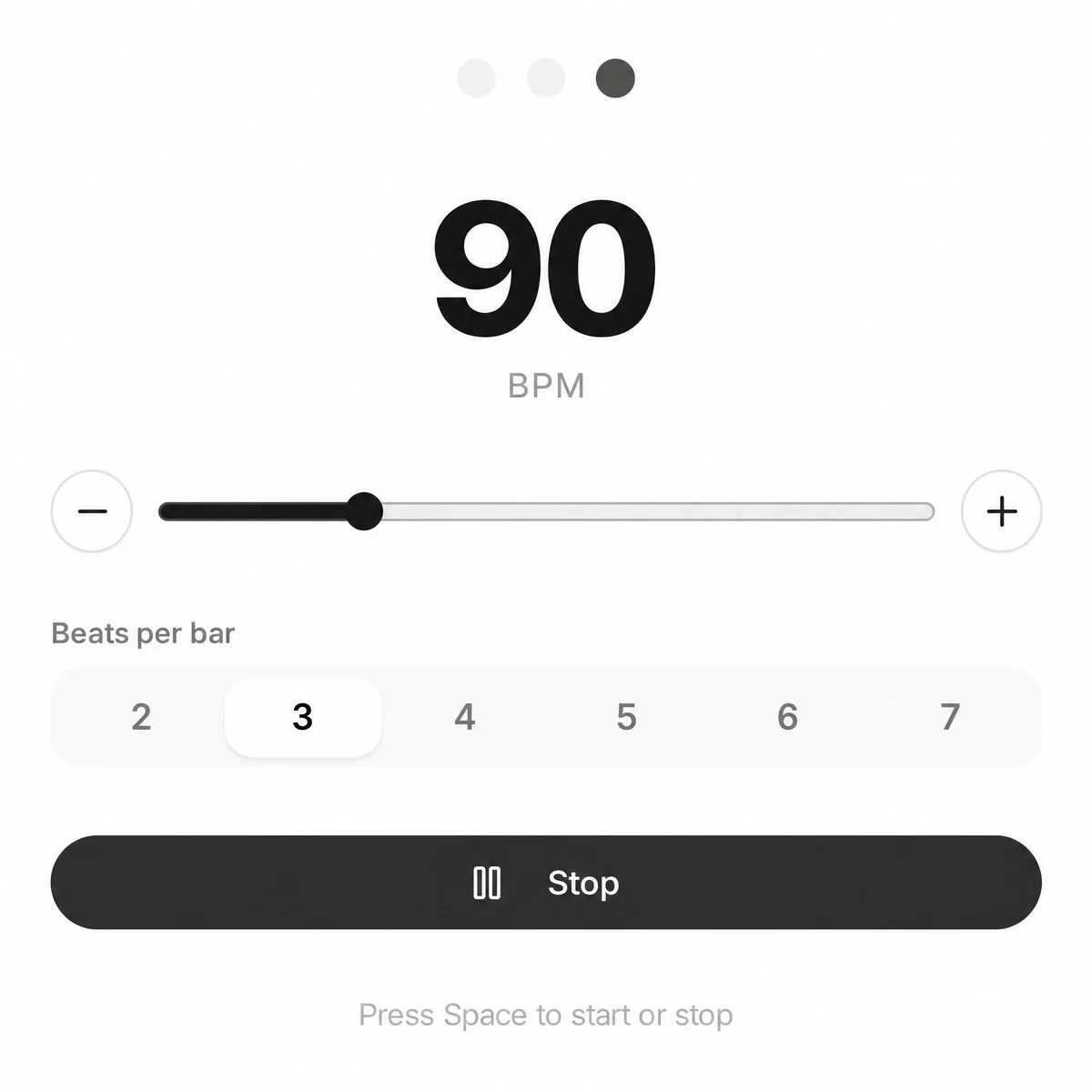
Try the routine on the SongDuet metronome: set the BPM, choose how many beats are in a bar, and the first beat of every bar clicks higher.
Open the metronomeMetronome terms worth knowing
- BPM
- Beats per minute. 60 BPM is one beat a second; 120 BPM is two.
- Beat
- The pulse you would tap your foot to. A metronome clicks once per beat.
- Downbeat
- Beat one of a bar. Many metronomes accent it so you can hear where each bar starts.
- Time signature
- The two numbers at the start of a score, such as 4/4 or 3/4. The top one is beats per bar.
- Subdivision
- Splitting a beat into smaller even parts: two eighth notes, three triplets or four sixteenths.
- Click track
- A metronome played into headphones during a recording or a live show.
- Metronome mark
- A note value and a number above the music, such as a quarter note = 96. M.M. stands for Maelzel’s Metronome.
- Rubato
- Stretching and pulling the time on purpose for expression; the opposite of playing strictly with the click.
So, what is a metronome? A ruler for time: one even click at the BPM you choose, used to practice, record and play together, then set aside once the pulse is your own.
Ready to put that pulse into a beat of your own? Our beat making guide goes from the first kick to export, and our list of free beat maker sites compares the places to make one.
Metronome questions
What is a metronome, and what does it do?
What is a metronome in one line: a device that clicks steadily at a speed you choose, in beats per minute. You play along to keep an even tempo, build speed on a passage, or record takes at one speed.
What is a good metronome speed for beginners?
Start where every note comes out right, often 60 to 80 BPM for a first year player, and creep upward a few beats at a time.
Is 120 BPM fast?
It is brisk but moderate: two beats a second, a march, on the border of moderato and allegro.
What does a marking like M.M. = 100 mean?
Set a metronome to 100 beats per minute, counted on the note value shown, usually a quarter note. M.M. stands for Maelzel’s Metronome.
Should I practice with a metronome all the time?
No. Use it to learn the time and build speed, then play without it so the pulse becomes your own.
Does the SongDuet metronome play subdivisions?
No. It clicks once per beat, with beat one of every bar accented, and you choose from 2 to 7 beats per bar. To practice eighths or triplets, count the subdivisions out loud between the clicks.
What is the difference between a metronome and a BPM finder?
A metronome produces a tempo for you to play to. A BPM finder works the other way: it measures the tempo of a song you already have.