Key Finder
Drop an audio file and see which key it is in, major or minor, with the Camelot code DJs mix by. The BPM comes with it. It costs nothing and the audio stays on your device.
Your file is analyzed right here in your browser, nothing is uploaded to a server.
Key finder in four steps: audio file to key
The key finder asks for four things, in this order.
1.Drop a song on the box
Drag an audio file onto the box or click to pick one. MP3, WAV, M4A, FLAC and OGG are named on the box; anything your browser can decode will do. While it reads Detecting key and BPM, the work happens inside your browser and nothing is sent anywhere.
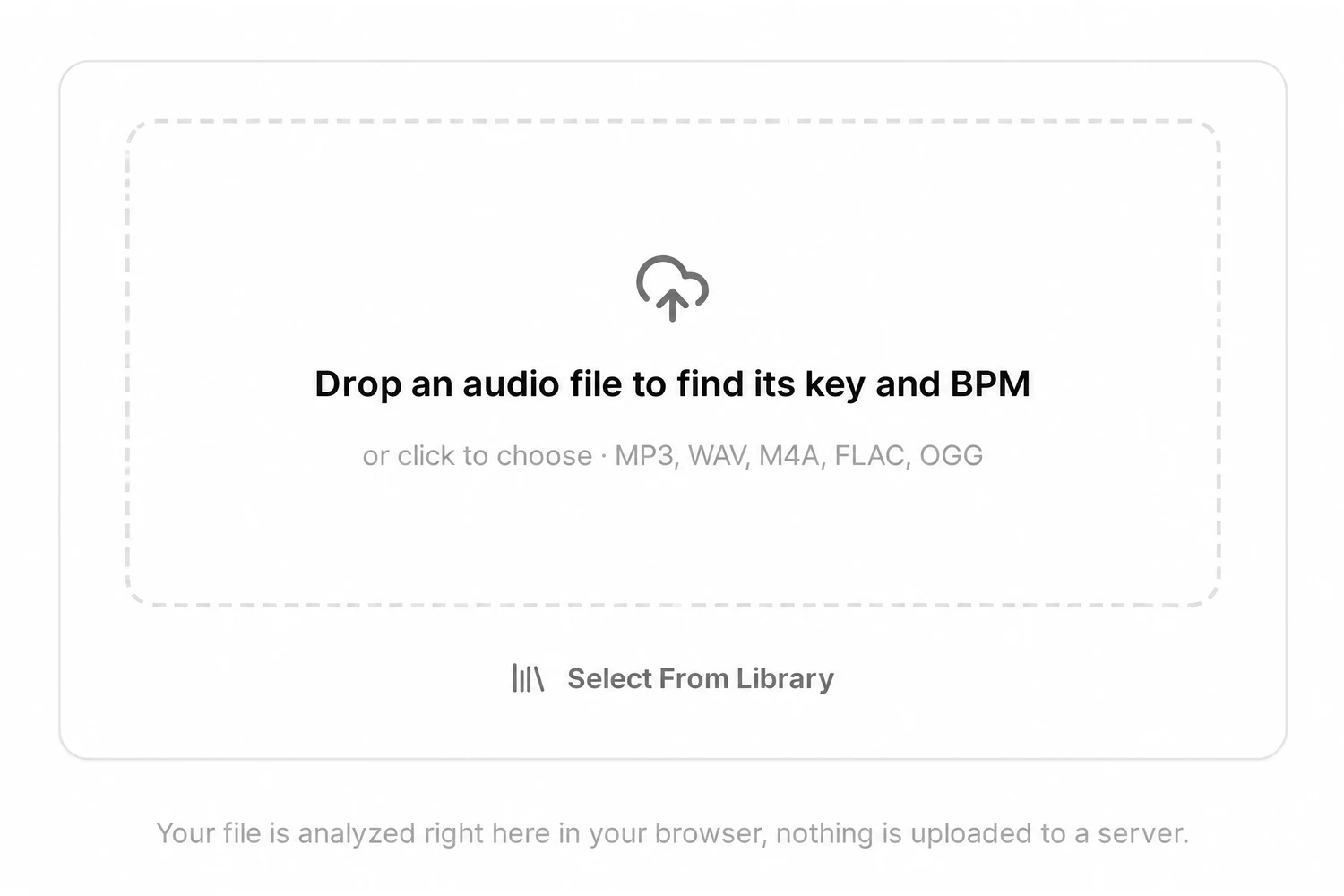
2.Read the key on the left
The large letter is the home note of the song. A small m after it means minor, and the line underneath spells it out, for example A Minor. Next to it you see the tempo in BPM.
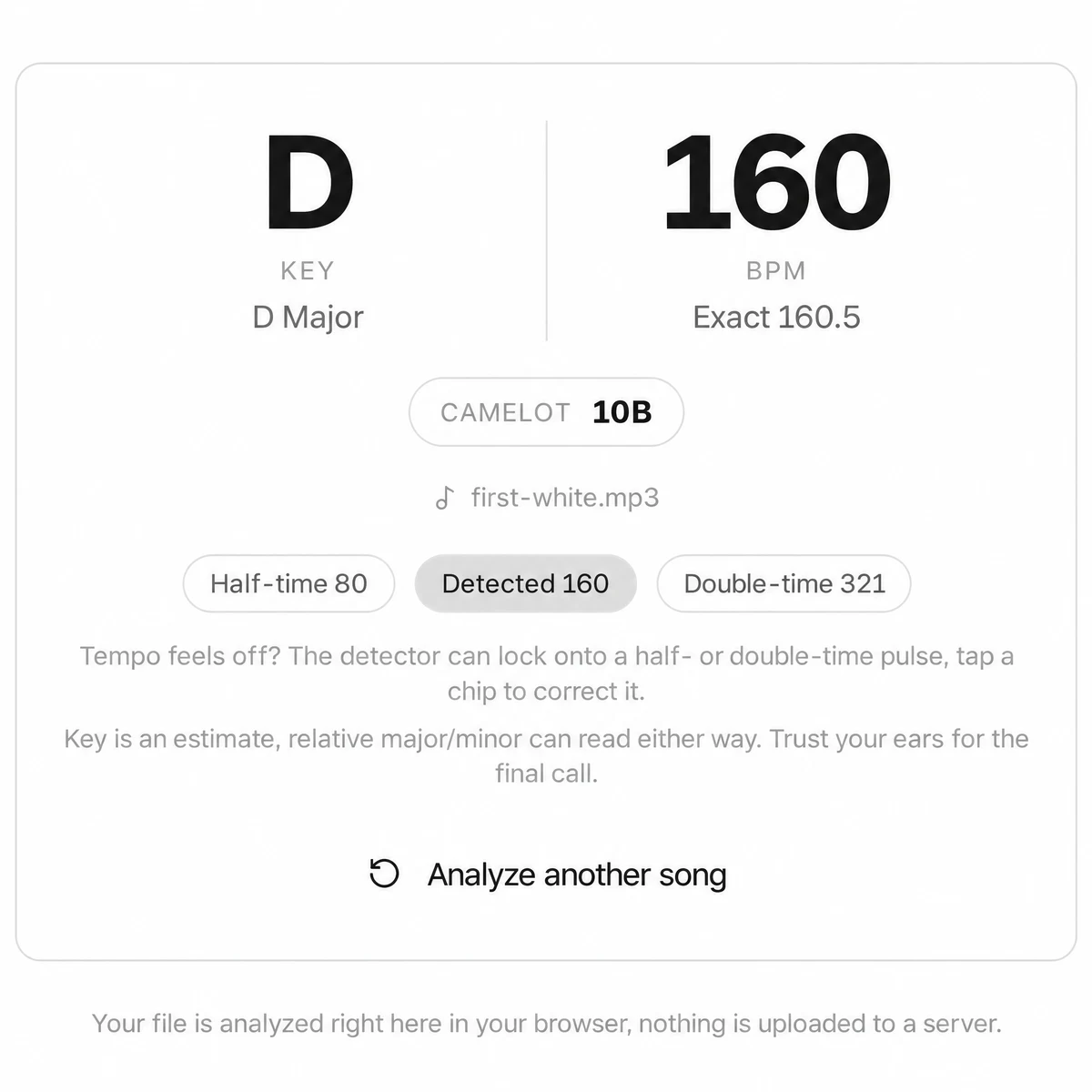
3.Note the Camelot code
Under the two numbers sits a code such as 8A. DJs use it to pick tracks that blend: neighbouring numbers and the same number with the other letter sit well together.
4.Check it by ear, then try the next file
Play the song and hum or play the note the key finder named. If it feels like home, you have the key. If it does not, see the section on results that look wrong below. Analyze another song clears the result.
Reading the BPM and key finder result: key, mode and Camelot code
What each part of the readout means once the analysis is done.
- Key letter
- The tonic, the note the song comes back to. The finder spells black notes with sharps: A# where a chart might write Bb.
- Major or Minor
- Shown as a small m on the big letter for minor, and written out in the line below it.
- Camelot code
- A number from 1 to 12 and a letter: A for minor keys, B for major keys. It turns the circle of fifths into a clock you can read at a glance.
- BPM
- The tempo of the same file, with Half-time and Double-time chips if the detector heard the pulse twice too slow or too fast.
Camelot codes for all 24 keys
Each number holds a minor key and its relative major: the same notes, a different home. Mix within a number, or step one number up or down.
| Camelot | Minor (A) | Major (B) |
|---|---|---|
| 1 | G# minor | B major |
| 2 | D# minor | F# major |
| 3 | A# minor | C# major |
| 4 | F minor | G# major |
| 5 | C minor | D# major |
| 6 | G minor | A# major |
| 7 | D minor | F major |
| 8 | A minor | C major |
| 9 | E minor | G major |
| 10 | B minor | D major |
| 11 | F# minor | A major |
| 12 | C# minor | E major |
Only need the tempo for your set? The song BPM finder reads it on its own, with the same Half-time and Double-time chips.
Why singers, DJs and producers check the key first
Knowing the key saves a wasted take, a clashing mix or a sample that will not sit.

Three reasons to check first
- Singers
- Find the key of the original before you record a cover, and decide whether it suits your voice before the session, not halfway through it.
- DJs
- Read the Camelot code to line up the next track so the two keys blend.
- Producers
- Check a sample against the project key before you start chopping it.
Once you know the key, the chord finder shows how to play its chords on guitar, piano or ukulele.
When the key result looks wrong
Key detection reads the notes of the whole song. These are the usual reasons it lands near, but not on, the key you expected.
- The finder says A minor, the song sounds like C majorRelative keysA minor and C major use the same seven notes and share Camelot number 8. Listen for which chord feels like rest at the end of the chorus and go with that.
- The result is one step around the circle, say G for a song in CA fifth awayKeys a fifth apart share six of seven notes, so a song that leans on its fifth chord can read that way. Check the last chord of the song.
- The song changes key for the last chorusOne key per fileThe finder gives the key that fits most of the file. Cut out the part you care about and analyse that piece on its own.
- The finder writes D# minor, your chart says Eb minorSame key, other nameThe finder always uses sharp names. D# and Eb are the same pitch, so nothing is wrong.
To check a result by ear, our guide to working out the key shows how to find it from the chords of the song.
What this key finder does not do
- Files, not song titles. The key finder reads audio you have. It cannot tell you the key of a song from its name or artist.
- No links. YouTube, Spotify and other web addresses are not accepted; the audio file is needed.
- Major and minor only. A song in a church mode still comes back labelled as a major or a minor key.
- No chord list. You get the key, not the chords of the song. For chord shapes, see the chord finder.
- No key changes listed. A song that modulates gets one key for the whole file.
- Your audio is left as it is. It reads the key; it does not shift the pitch or save a new file.
Key finder questions
Does the key finder cost anything?
No. Reading the key and tempo of a file is free, with no account and nothing to install. The only part that asks you to sign in is Select From Library, which lists songs you made on SongDuet.
Is my file sent to a server?
No. Your browser decodes the audio and the key detection runs on your own device.
How does it work out the key?
It mixes the song to mono, measures how much of each of the twelve notes sounds across the whole file, and compares that profile with the 24 major and minor key profiles published by Krumhansl and Kessler. The closest match is the key you see.
How sure is the result?
Think of the answer as a well informed starting point. Relative major and minor keys use the same notes, so the key finder can land on either, and a key a fifth away is the other common slip. The page says the same thing under the result: trust your ears for the final call.
Can I ask what key a famous song is in by typing its name?
No. This page has no song database. If you have the track as a file, drop it on the box and you get the key from the sound itself.
What is the Camelot code for?
Harmonic mixing. Tracks with the same code, a number one up or down, or the same number with the other letter tend to blend without clashing. The table on this page lists all 24 keys with their codes.
Why does it also show BPM?
The same analysis reads the tempo, so you get both from one drop. If you only need the tempo, the BPM finder page does just that.
Will my MP3 or FLAC file open?
The box names MP3, WAV, M4A, FLAC and OGG. It reads whatever your browser can decode, so support can differ a little between browsers.