How to Write a Song
Here is how to write a song the way working songwriters do: one idea, a title, the chorus first, verses that show a scene, chords, a melody and a rough demo, then the rewrite. One original song is built step by step below, with bar counts.
How to write a song: the first fifteen minutes
You need less than you think. A beginner's first song needs an idea and a way to keep it, not gear.
- Something to catch ideas. A notebook and the voice memo app on your phone. Most melodies arrive away from the desk, and a ten second hum you recorded beats a perfect one you forgot.
- One instrument, or none. Three or four chords on guitar or piano are enough for a first song. If you play nothing yet, you can still write the words and the tune and add chords later.
- A deadline. Give yourself one sitting for a rough first draft. Finishing a weak song teaches more than polishing half of a good one for a month.
- The fifteen minute warm up. Set a timer. Write down five things you saw or heard today, pick the one that made you feel something, and write one sentence about why. That sentence is your song idea.
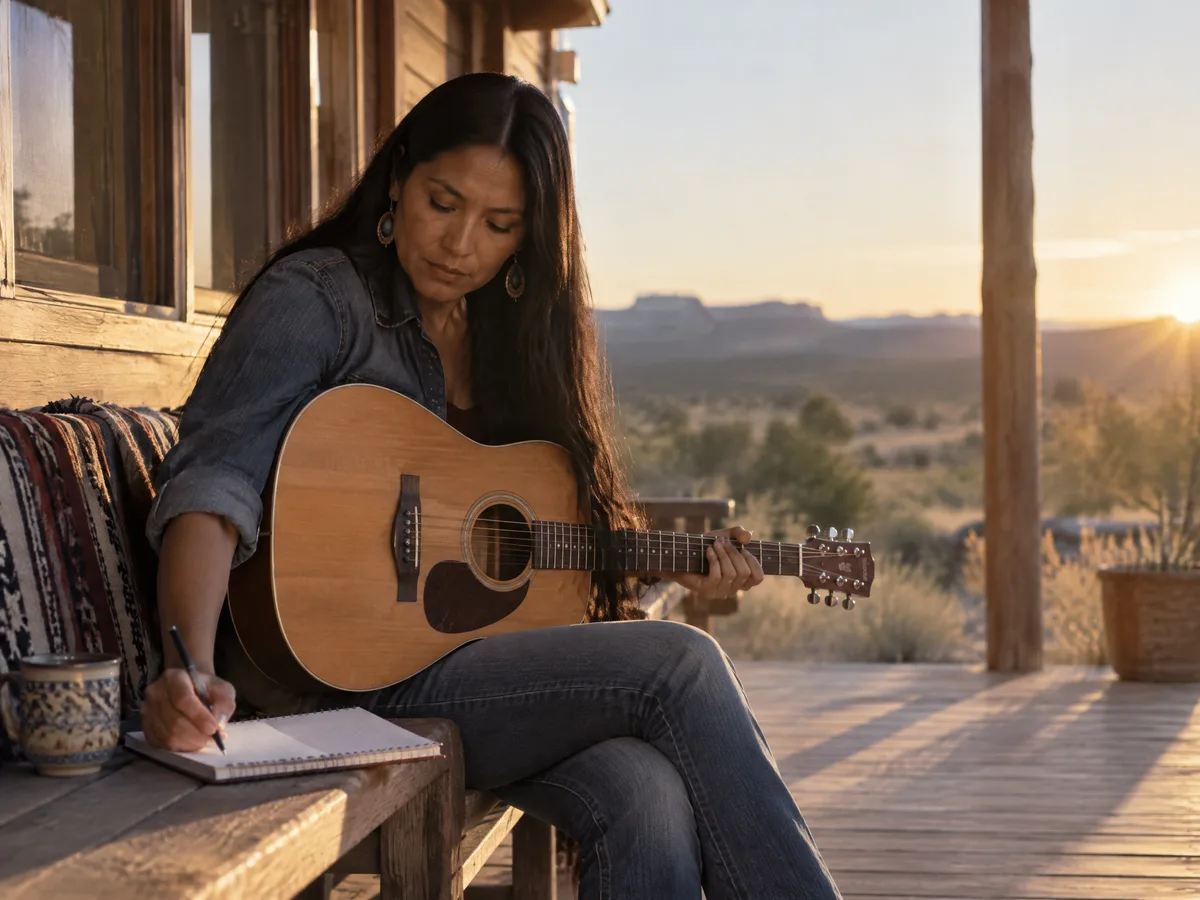
Catch the idea where it lands
A notebook and a phone are enough. Write the line down or sing it into a voice memo the moment it arrives, with the chord you were playing next to it. Shaping it can wait; losing it cannot be undone.
How to write a song in nine steps
The order most songwriters end up using once they know how to write a song quickly. Each step ends with one tip to try on your own draft.
1.Say the idea in one sentence
Before any rhyme, write what the song is about as if you were telling a friend: who, what happened, how it feels. "I keep the porch light on for my son the way my mother did for me" is a song. "Love and family" is a topic, and topics are hard to sing.
Tip. If you cannot say it in one sentence, you have two songs. Pick one.
2.Find the title and the hook line
Look for a short phrase inside your sentence that carries the feeling and is easy to sing: three to six words, ending on an open vowel if you can. That phrase becomes the title and the line people remember.
Tip. Say the title out loud ten times. If it still sounds good on the tenth, keep it.
3.Write the chorus first
The chorus states the main feeling plainly and puts the title in its first or last line, often both. Keep it to four lines, keep the words simple, and let it repeat. Everything else in the song exists to make this part land.
Tip. A chorus that explains is weaker than a chorus that declares. Save the details for the verses.
4.Write verse one as a scene
Verses show what the chorus tells. Use things a camera could see: a time, a place, an object, something someone said. Verse one sets up the situation; verse two should move it forward, not repeat it in new words.
Tip. Circle every abstract word (love, pain, forever) in your verse and swap at least half of them for something concrete.
5.Put chords under it
Start with a progression that is known to work and make it yours with rhythm and melody. In the key of C, try C, G, Am, F (I, V, vi, IV) for a lifting chorus, and Am, F, C, G for a darker verse. Changing chords less often in the verse and more often in the chorus is an easy way to add energy.
Tip. Play the chorus chords a little higher on the neck or keyboard than the verse chords. Your voice will follow.
6.Find the melody by singing over the chords
Loop the chords and sing the lyrics on whatever notes come out, recording every pass. Then pick the best phrases. Keep the verse lower with more words per bar, and lift the chorus with fewer, longer notes. The hook should land on a strong beat.
Tip. Speak the line first and notice which syllables you stress. The melody should put those same syllables on the beat.
7.Arrange the sections
Lay out the parts in order: intro, verse, pre-chorus, chorus, second verse, chorus, bridge, final chorus. A pre-chorus builds tension before the chorus; a bridge brings something new (a different chord, a new angle on the idea) right when the listener expects one more chorus. The structure section below gives bar counts.
Tip. If the song drags, cut the second pre-chorus or shorten the intro before you touch the chorus.
8.Record a rough demo
Phone on the table, one take of voice and guitar or piano, start to finish. You are not making a record yet; you are finding out whether the song works when it plays straight through.
Tip. Listen back the next day, away from the instrument, and write down the first moment your attention drifts.
9.Revise with fresh ears
Check every line against your one sentence idea and cut what does not serve it. Replace phrases you have heard in other songs, make sure no line is there only for the rhyme, and sing the whole thing again. Most good songs are rewritten more than they are written.
Tip. Fix the chorus first, then the first verse. Listeners decide in those two places.
Want to hear the idea sung with a full band before you can play it? Describe the song in one sentence and SongDuet's song maker sings it back, with two takes to choose from.
Open the song makerThe same idea in the song maker
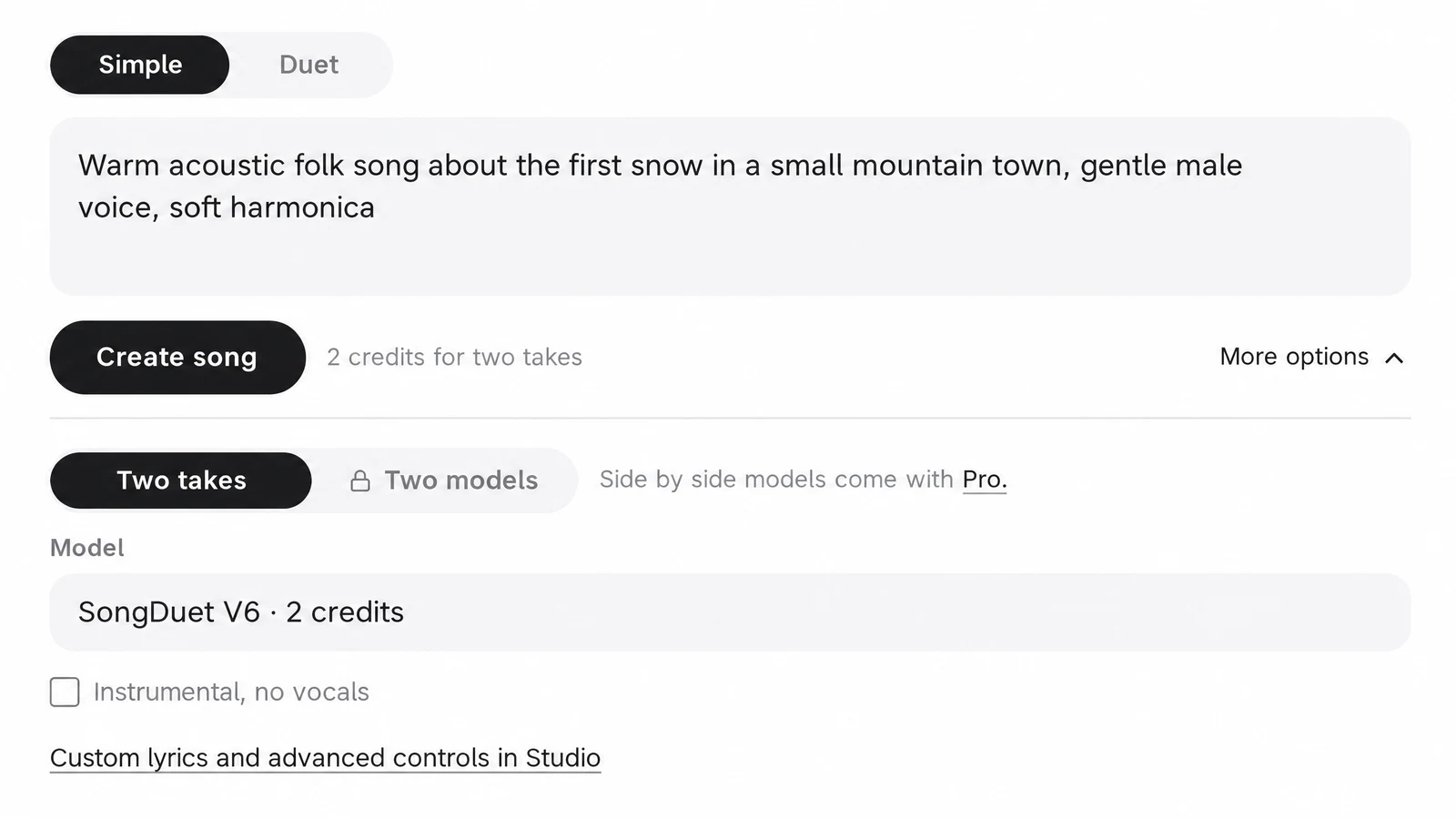
1.Describe the song
In Simple mode, write what the song is about and how it should sound. Generating needs a signed-in account, and the price shows before the run.
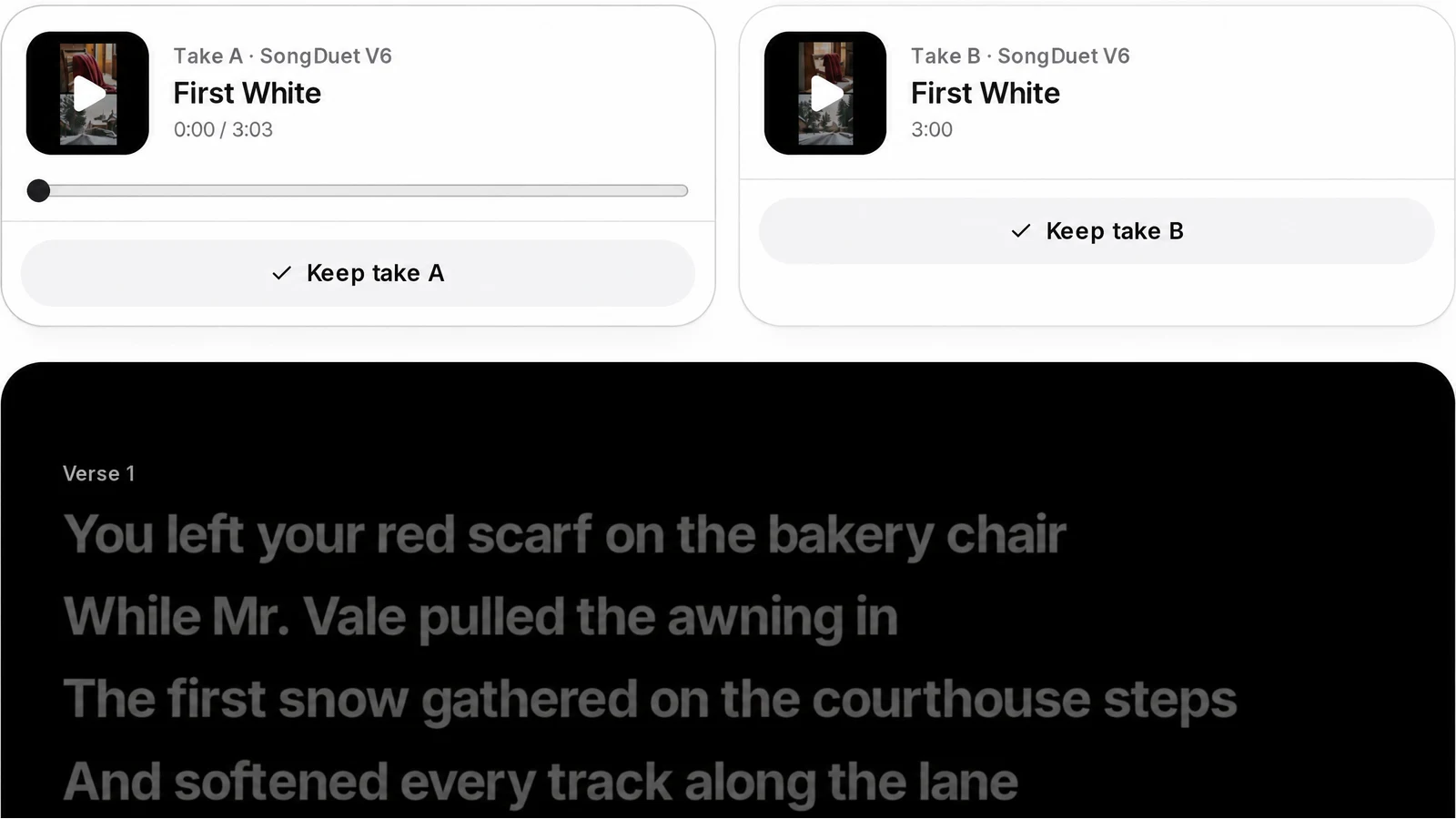
2.Pick the stronger of two takes
Each run returns two takes on a takes page. Keep the one you would sing again; it also lands in your Studio library.
Worked example: a chorus, before and after
Idea sentence: I keep the porch light on for my son the way my mother did for me. Here is the first chorus that came out, and the rewrite.
Revision Leave the porch light on I'll find my way along However late, however long Leave the porch light on
- The draft could be about anyone. The porch light is this family's object, so the listener sees it.
- The title opens and closes the chorus, which is what makes it the hook.
- On, along, long share one open vowel a singer can hold.
- The third line is longer than the others, so the melody can climb there before the title returns.
What makes a chorus catchy is mostly this: a concrete image, the title repeated where the ear expects it, short lines, open vowels, and one line that breaks the pattern.
The words get a lesson of their own in our guide to writing lyrics that sound right when sung: a verse drafted and revised, rhyme schemes with sample lines and ten starters for a blank page.
Song structure with bar counts
The same song laid out section by section. 64 bars in 4/4 time, about two minutes and 47 seconds at 92 BPM.
| Section | Bars | What happens |
|---|---|---|
| Intro | 4 | Chorus chords, no vocal |
| Verse 1 | 8 | The scene: kitchen, ten at night |
| Pre-chorus | 4 | Climbs toward the chorus |
| Chorus | 8 | Title in the first and last line |
| Verse 2 | 8 | Moves the story on a generation |
| Pre-chorus | 4 | Same melody, new words |
| Chorus | 8 | Same words |
| Bridge | 8 | New chord, new angle |
| Chorus | 8 | Last line repeated |
| Outro | 4 | Fades on the hook |
Working out the length
One bar of 4/4 at 92 BPM is four beats of 0.65 seconds, about 2.6 seconds. 64 bars is 256 beats, and 256 divided by 92 is 2.78 minutes: roughly two minutes and 47 seconds.
To shorten it, drop the second pre-chorus (four bars) and halve the intro. To make the last chorus hit harder, leave the bridge's last two bars nearly empty.
Tips to write a song in pop, country, ballad and rock
Habits, not rules. Start from these when you are writing in a style for the first time, then break one on purpose.
| Style | Tempo | Common form | What to lean on |
|---|---|---|---|
| Pop | 95 to 125 BPM | Verse, pre-chorus, chorus twice, then a bridge | Four chord loops; the title sung many times in the chorus |
| Country | 75 to 115 BPM | Two rounds of story then refrain, a bridge late | Story with names and places; a twist in the last verse |
| Ballad | 60 to 80 BPM | Longer verses and a chorus that lifts | Slow chord changes and room for long notes |
| Rock | 110 to 150 BPM | Verse, chorus, instrumental break | A riff first; short, punchy lines |
| Love song | Any | Any | One specific moment instead of always and forever |
How to write a song with help from AI
Sometimes you need to hear the song before you can finish it, or need lines to push against. Two tools on SongDuet do that; neither writes your song for you unless you let it.
The song maker turns a short description into a complete sung song, or an instrumental if you switch vocals off. From there, Custom lyrics and advanced controls in Studio opens the song form, where an AI music model sings lyrics you wrote. Tags such as [Verse], [Chorus] and [Bridge] go to the model as you typed them, so your structure from the section above carries over. Every run returns two takes; finished songs download as MP3, and SongDuet V6 songs also as WAV.
Stuck on the second verse? The lyrics generator writes complete lyrics with verse, chorus and bridge tags from a short description, so you have lines to react to.
Open the lyrics generator- The melody comes from the AI. You cannot hum, upload or draw a melody for your lyrics. Use it to hear an arrangement, then keep writing your own tune if you want one.
- Lines may be stretched. The model sings your lyrics as given but may repeat, stretch or skip a line to fit the music.
- Guidance, not a grid. Section tags and style words steer structure, tempo and mood most of the time, but the result can drift, and there is no exact BPM setting.
- Account and credits. Each run is billed to your account in credits once you sign in. You see the cost on the button first, and a failed run gives the credits back.
Songwriting terms used on this page
- Hook
- The line or melody people remember after one listen, usually the title in the chorus.
- Verse
- The sections that tell the story. Same melody each time, new words.
- Chorus
- The repeated section with the main feeling and the title. Same words each time.
- Pre-chorus
- A short section between verse and chorus that builds tension.
- Bridge
- A contrasting section, usually once, near the end, before the last chorus.
- Bar
- One measure of music. In 4/4 time a bar holds four beats.
- Prosody
- How well the words, their natural stresses and the melody fit each other.
- Topline
- The vocal melody and lyrics together, written over existing chords or a track.
Questions about writing a song
Do I need to play an instrument to write a song?
No. Many songwriters hum melodies into a phone and work out chords later, or write with someone who plays. An instrument helps you hear the chords under the tune, but lyrics, title and melody can all start without one.
Should I write the lyrics or the music first?
Either works. Starting from a title and a chorus lyric keeps the song about something; starting from a chord loop or a hummed melody keeps it singable. Whichever you start with, bring the other in early so the stresses of the words and the beat of the melody agree.
How long should a song be?
Most songs on the radio and on playlists run between about two and a half and four minutes. Count it in bars: at 92 BPM in 4/4 time, the 64 bar layout on this page lasts about two minutes and 47 seconds.
What goes into a good bridge?
Change one thing the listener has got used to. Start on a chord the song has not used yet, shift the lyric to a new angle (the other person, the future, a confession), and hold back the title so the last chorus feels like coming home. Eight bars is plenty.
How do I get past writer's block?
Lower the bar: write a deliberately bad verse in ten minutes, then fix it. Change one condition, such as a new key, a new instrument, a different room or a strict rule like no rhymes. Go back to the five things you noticed today.
Can I use a chord progression another song uses?
Common progressions such as I, V, vi, IV appear in thousands of songs and are building blocks everyone shares. What makes a song yours is the melody and the words, so write those fresh and never borrow lines from a released song.
Can AI help me write a song?
Treat it as a sparring partner. Here, one sentence in the song maker comes back as a sung song in two takes; the Studio song form sings words you typed; the lyrics generator hands you draft verses to argue with. The tune is always the model's own, and every run is billed in credits to a signed in account.