How to Write Song Lyrics
Learning how to write song lyrics starts with one fact: they are written for the ear, not the page. This guide goes from choosing one moment to a revised verse you can sing, with an original draft and its rewrite, ten starters, rhyme schemes with sample lines and the terms songwriters use.
How to write song lyrics in seven steps
Work in this order the first few times. Later you will jump around, but the chorus still tends to get written before the second verse.
1.Pick one subject and one moment
A breakup is a subject; the afternoon you returned her bike is a moment. Lyrics written from one moment feel true, because the details are real. Write two sentences: what happened, and what you could not say at the time.
2.Write the title line
Pull a short phrase from those sentences that you would want to sing over and over. Ordinary words used in a slightly new way work best. This line goes in the chorus, usually first or last.
3.Build the chorus around the title
Four lines that say the heart of the song plainly. Repeat the title, keep the vocabulary simple and leave space: a chorus is sung on longer notes, so it holds fewer words than a verse.
4.Write the verses as scenes
Verse one shows the situation with objects, places and things people said. Verse two moves time forward or turns the camera on someone else. If you can swap your two verses without anything breaking, verse two is not doing its job yet.
5.Rhyme, but let the meaning win
Pick a scheme (the table below has four) and rhyme on words that matter. Near rhymes such as home and alone sound natural in modern songs; a perfect rhyme that forces a weaker word is worse than none.
6.Count syllables and stresses
Lines that sit in the same place in each verse should have about the same number of syllables and stresses, so they fit one melody. Read the line aloud, tap the stressed syllables, and make sure no unimportant word lands on a strong beat.
7.Revise out loud
Sing or speak every line. Cut filler words (just, really, so), replace any phrase you have heard in a hundred songs, and remove lines that exist only to rhyme. Then read it to one honest person and watch where they look away.

Worked example: one verse, drafted and revised
The moment: selling my late father's pickup truck to a stranger. The first draft names the feelings. The revision shows the scene and lets the listener feel them.
- Sad, pain and miss are gone. Cash on the hood and the left behind sunglasses carry the grief.
- The rhyme moved from sad sounding filler (pain, rain) to words that matter: hood, good, door, before.
- Syllables run 10, 9, 10, 9, so lines one and three share a melody, and so do two and four.
- The last line answers a practical question with an emotional one. That turn is the verse's reason to exist.
Scheme: ABAB. Stresses in line one: the BUY er COUNTS out TWEN ties ON the HOOD, five strong beats a melody can sit on.
Ten prompts for a blank lyric page
Fill in a blank or follow a rule for ten minutes. Constraints get words moving faster than waiting for inspiration.
- 1.The last time I saw ___, it was ___.
- 2.Nobody told me ___ would feel like ___.
- 3.I still have your ___ in my ___.
- 4.If this ___ could talk, it would say ___.
- 5.Every ___ at ___ o’clock, I ___.
- 6.Write the chorus as a text message you never sent.
- 7.Describe one room: three objects, no feelings named.
- 8.Start with a sentence someone really said to you.
- 9.Write a verse where no word is longer than two syllables.
- 10.Say the opposite of what you mean, and the truth in the last line.

Ten minutes, one rule, then stop
Pick one starter, set a timer and write without crossing anything out. When the time is up, close the notebook. Tomorrow you read it with fresh eyes and keep the two lines that still sound true.
How to write song lyrics that rhyme: schemes and sample lines
Four patterns cover most songs. Use one per section and switch between verse and chorus to make the chorus feel different.
| Scheme | Which lines rhyme | How it feels | Sample |
|---|---|---|---|
| AABB | Lines 1 and 2 rhyme, then 3 and 4 | Settled, easy to follow | Coffee on the stair / your coat is hanging there / I fold it like a letter / it doesn’t make it better |
| ABAB | Lines 1 and 3, then 2 and 4 | Moves forward, a little more tension | The streetlights blink at two / the bus is running late / I’m thinking about you / and learning how to wait |
| XAXA | Only lines 2 and 4 rhyme | Closest to speech, common in verses | We painted the kitchen yellow / the year that we moved in / now the paint is peeling / and the walls are wearing thin |
| ABBA | Outer lines rhyme, inner lines rhyme | Opens a thought and closes it | I kept the key / it opens nothing now / I don’t know how / to set it free |
Getting your lyrics sung
Lyrics only prove themselves in a melody. If you do not have one yet, you can hear yours sung over a full arrangement.
Mark each block with a section tag, keep the chorus words identical every time it comes back, and put one sung line on each line of text. In the SongDuet Studio song form, Custom mode sings lyrics you wrote, and tags such as [Verse], [Chorus] and [Bridge] are passed to the model as you typed them.
The tune is the model's own, and a line can come back doubled, drawn out or dropped where the music needs it. Lines that sound rushed usually carry too many syllables. You hear two takes from every run and keep the better one. Once the words are sung, our guide to making a lyric video shows how to time them line by line on screen.
[Verse 1] The buyer counts out twenties on the hood I leave your sunglasses in the door [Chorus] Drive it like you mean it Drive it like it's yours
Hear your lyrics sung: start in the song maker and open Custom lyrics in Studio to paste your own words.
Open the song makerHow to write song lyrics with AI as a first draft
When the page stays blank, a draft to disagree with can help. Keep what sounds like you and rewrite the rest.
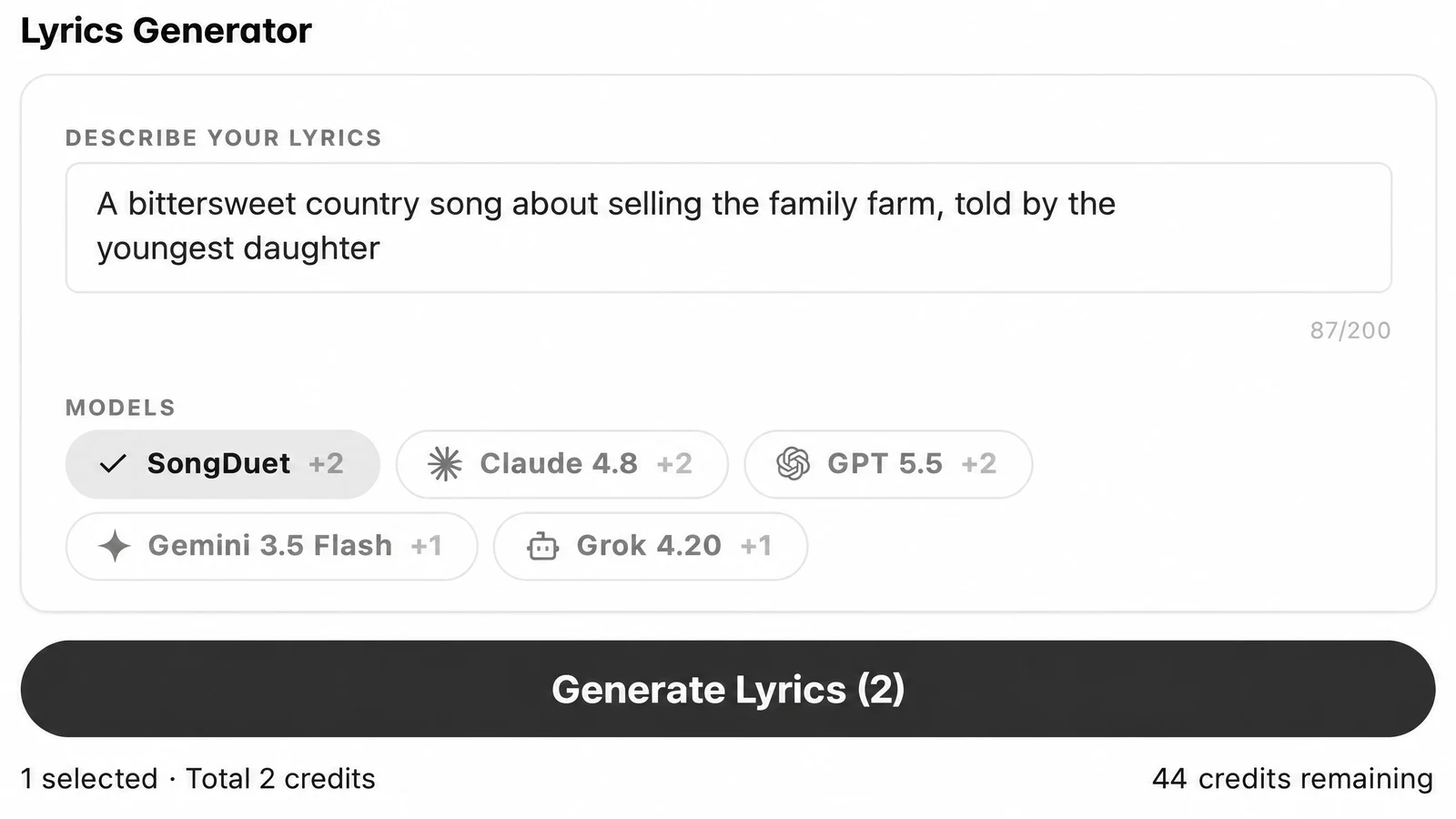
Describe the song in a line and the lyrics generator writes complete lyrics with verse, chorus and bridge tags, up to two versions per model, side by side.
Open the lyrics generator1.Describe the song in a line
Say who is singing, what happened and how it should feel. One or several AI models then write complete lyrics from it.
2.Compare the versions, copy what you keep
Each model returns up to two versions with tags such as [Verse 1] and [Chorus], each with a copy button. Treat them as a draft to rewrite in your own words.
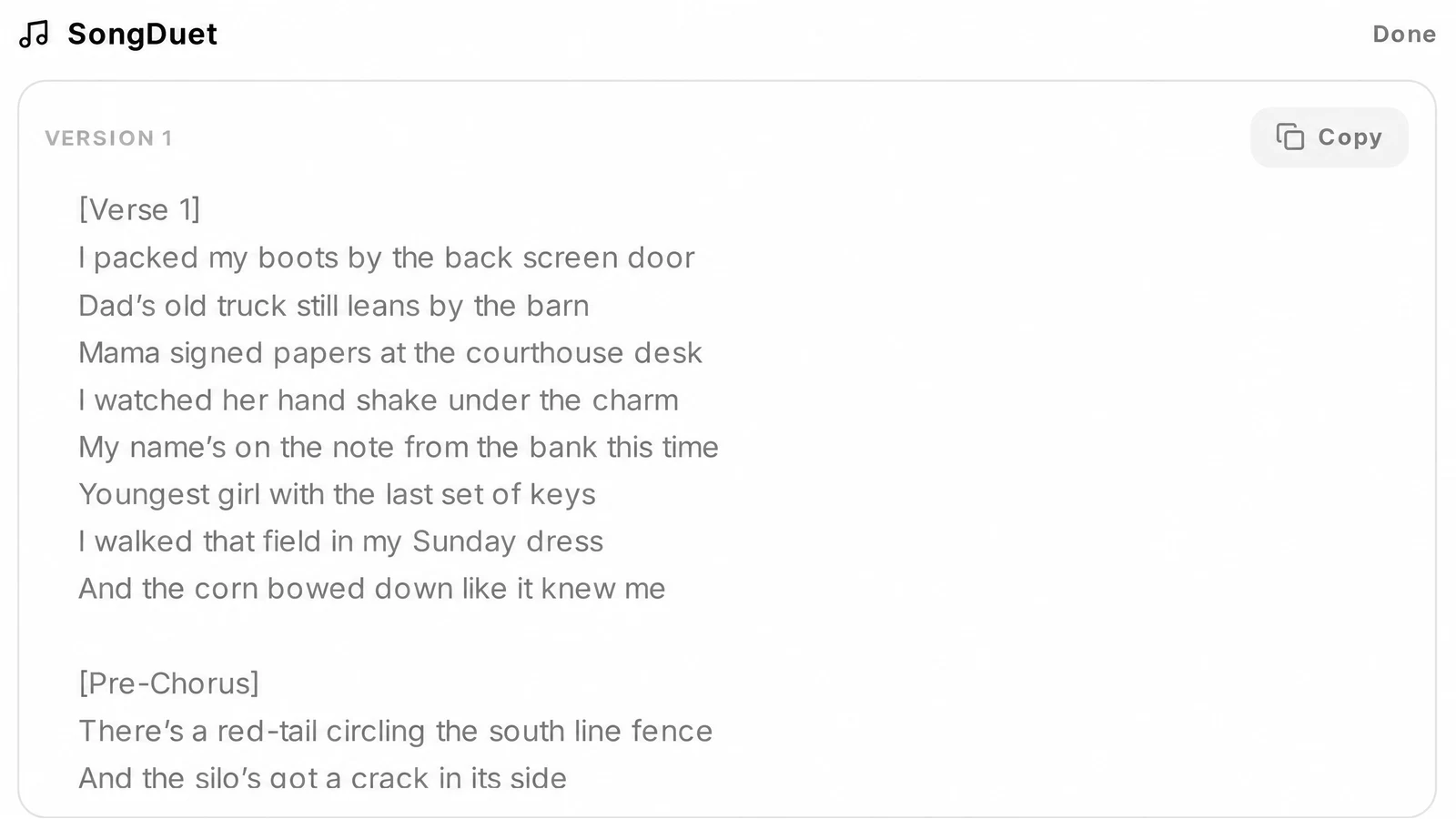
- A draft, not a finished lyric. There are no rhyme scheme, line count or syllable controls beyond what your description says. Expect to edit.
- Copied out by you. Each version has a copy button; there is no lyric editor, saved draft or file download in the generator.
- No borrowed songs. Ask it for a song in the voice of a famous singer, or a reworded hit, and you will not get one. Its drafts start from your description.
- Account and credits. You sign in to run it, each model shows its price before you start, and a failed run is refunded.
Lyric writing terms
- Perfect rhyme
- Same vowel and ending sound: light and night.
- Near rhyme
- Close but not identical sounds: home and alone, mind and time. Also called slant rhyme.
- Internal rhyme
- A rhyme inside a line rather than at the end of it.
- Prosody
- The fit between the meaning, the natural stress of the words and the melody.
- Hook
- The line the listener walks away humming, usually the title.
- Section tag
- A label such as [Verse] or [Chorus] written above a block of lyrics to mark its role.
- Mumble track
- A melody sung with nonsense syllables, used to find the rhythm before the words exist.
- Cliché
- A phrase so familiar the listener stops hearing it: broken heart, tears like rain.
Questions about writing lyrics
Do song lyrics have to rhyme?
No, but most popular songs rhyme at least some line endings, because rhyme helps listeners predict and remember. Near rhymes count. Unrhymed lyrics work best when the rhythm of the lines is strong and steady.
How many lines should a verse have?
Four or eight lines is the most common, matching melodies built in four or eight bars. What matters more is that verse one and verse two have the same number of lines with similar lengths, so they share a melody.
Should I write the lyrics before the melody?
Either way works. If the words come first, read them aloud and mark the stresses so the melody can follow them. If the melody comes first, sing it with nonsense syllables, count the syllables in each phrase, and write words that fit those counts.
Should every chorus use the same words?
Usually yes. Repetition is what makes a chorus a chorus. A common move is to change one line in the last chorus so it lands differently after the bridge.
How do I stop writing clichés?
Notice the phrase that arrived too easily and ask what you actually saw or heard. Replace the general word with a specific one from your own life: not a broken heart, but the voicemail you have not deleted.
How do I write lyrics if I am a beginner?
Start small: one moment, one title line, one four line chorus. Use a starter from the list above, write for ten minutes without editing, then apply the revision step. Finishing short songs teaches faster than planning long ones.
Can AI write song lyrics for me?
It can hand you raw material. Give the SongDuet lyrics generator a line about your song and it returns tagged verses, a chorus and a bridge, at most two takes from each model you picked; copy one out and rewrite it until it sounds like you. Runs are billed in credits to a signed in account.