Vocal Range Test
Press Start test, sing down to your lowest note and up to your highest. The test keeps both, shows your range in octaves and semitones and the closest voice type. No cost, no sign up.
Or analyze an isolated vocal stem from your library to read its range.
How to take the vocal range test online
Four moves, about a minute. Sing at a comfortable volume; loud does not help.
1.Press Start test
Your browser asks to use the microphone. Allow it. The big display shows the note you are singing as soon as it hears one.
2.Sing down to your lowest note
Start on a comfortable note and slide or step down on an easy vowel such as "ah" or "oh". Hold the lowest note you can sing steadily for a moment. Lowest note fills in.
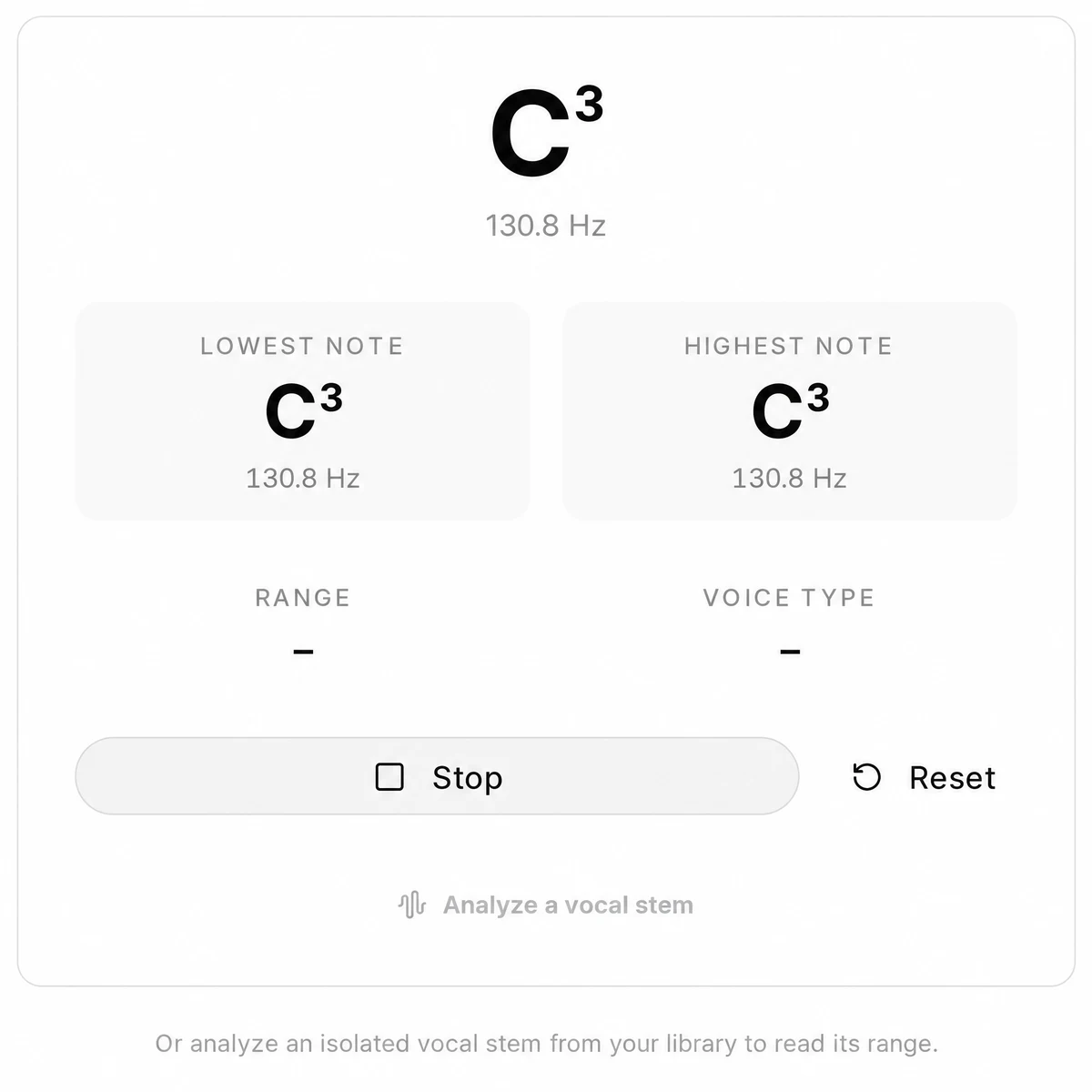
3.Sing up to your highest note
Now go up the same way and hold the top note you can sing cleanly. Highest note fills in, and the test shows your range in octaves and semitones and the closest voice type.
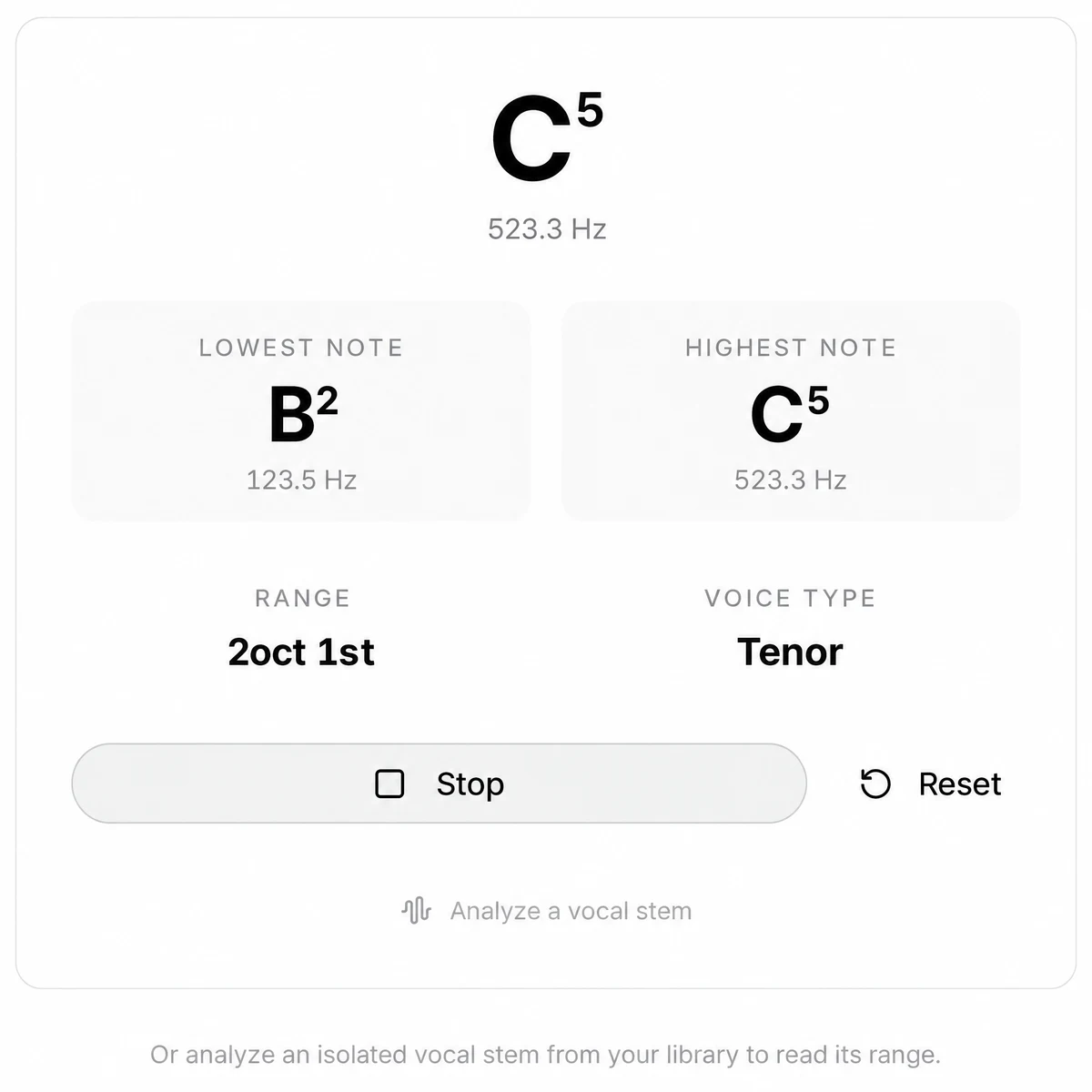
4.Press Stop, or Reset and try again
Stop turns the microphone off and keeps the result on screen. Reset clears it. Voices loosen up, so a second run after a short rest often reaches a little further.
Six voice types on one scale
These are the reference ranges the test compares your two notes against. The one closest to your lowest and highest note is the voice type it shows.
- BassE2 to E4
- BaritoneA2 to A4
- TenorC3 to C5
- AltoF3 to F5
- Mezzo-sopranoA3 to A5
- SopranoC4 to C6

Vocal range test tips for a reading you can trust
The test keeps the most extreme steady notes it hears, so a clean run matters more than a loud one.

Warm up, then hold each note
Hum or sing a few easy slides first. A cold voice gives you a smaller range than you really have. To practise holding one pitch steady, sing into the chromatic tuner and watch the cents meter settle.
Hold the bottom and the top note for a moment rather than touching them on the way past; a note only counts when it holds. Stop where the sound turns to a growl or a squeak you could not use in a song.
Test in a quiet room, away from fans and speakers, so a background hum is not read as your lowest note.
What your result tells you, and what it does not
Two notes say a lot about range and less about voice type.
What it is. Your lowest and highest steady note today, the distance between them, and the closest of six reference ranges. Run it again after warming up or on another day and compare.
What it is not. A voice type diagnosis. The test does not hear tone colour, the weight of your voice or where it changes register, and it cannot tell which notes are comfortable to sing for a whole song.
To check a song against your range, find the key of the song first, then pick a key that keeps its melody between your two notes.
Your voice live, or a recorded vocal
The same test has two inputs.
- Find the range of your own voiceStart testSing into the microphone. No account, and the audio is read in your browser, not uploaded.
- Read the range of a finished vocal you split in the StudioAnalyze a vocal stemSigned in, pick a vocal track from My Stems. The browser scans the whole recording and shows its lowest and highest note, range and voice type. Notes that show up only rarely are left out, so a stray breath does not stretch the range.
Clean, steady takes of your own voice are also what an AI voice clone learns from: SongDuet can train a private singing voice on your vocals and use it to cover songs in the Studio.
The numbers behind the vocal range test
Read from the test itself, so you know what it measures.
| Notes counted | C2 to C6 (65 to 1100 Hz); sounds outside that window are treated as noise |
|---|---|
| When a note counts | It has to hold for two readings in a row, so a single glitch cannot set a false lowest or highest note |
| Shown live | The note you are singing, with its octave and frequency |
| Result | Lowest note and highest note with frequency, the range in octaves and semitones, and a voice type |
| Voice types | Bass, Baritone, Tenor, Alto, Mezzo-soprano, Soprano; the closest reference range to your two notes wins |
| Where it runs | In your browser; the microphone audio is not uploaded and the test needs no account |
| Stem analysis | Signed in only; reads a vocal track from My Stems instead of the microphone |
Where this test stops
It measures range. Here is what it leaves to you.
- No song suggestions. It tells you your notes, not which songs suit them. Compare your lowest and highest note with the melody of a song you want to sing.
- Nothing is saved. The result stays on screen until you press Reset or leave the page. Write it down or take a screenshot.
- No recording or playback. The test listens but does not record, so you cannot play your attempt back.
- No exercises or lessons. There are no warm ups, pitch matching games or reference piano notes to sing along with.
- C2 to C6 only. Notes below C2 or above C6 are ignored, so very low basses and the highest head voice and whistle notes are not counted.
- No file upload. You cannot drop an audio file from your computer here. A recorded vocal can only be read from My Stems, signed in.
Vocal range questions
Is this vocal range test free?
Yes. The microphone test runs in your browser with no account, no sign up and nothing to install, and the audio is not uploaded.
What is a normal female or male vocal range?
Most untrained voices cover about one and a half to two octaves. Among the six reference ranges this test uses, women most often land on Alto, Mezzo-soprano or Soprano and men on Bass, Baritone or Tenor, but the test does not ask your gender and many voices fall between types.
How accurate is the voice type?
It is an estimate from two notes: the type whose reference range sits closest to your lowest and highest note. A teacher also listens to tone, weight and where the voice changes register, which a microphone test cannot judge.
Should I count falsetto or head voice?
The test counts any steady note, falsetto included. If you want your chest voice range only, stop where your voice flips and run the test again for the full range.
What does a result like 1oct 7st mean?
One octave and seven semitones between your lowest and highest note. An octave is twelve semitones, so that is nineteen semitones in all.
Can I take the test on a phone?
You can, in the phone browser. Accept the microphone prompt, then keep the phone about a hand span from your mouth rather than pressed to your lips.
Why did my lowest note come out too low?
A hum from a fan, traffic or a buzzing device can be read as a low note if it holds steady. Test in a quiet room, press Reset and sing again.