How to Find the Key of a Song
Find the chord that feels like home, check that the rest belong to its family, then decide between major and relative minor. Tables for every key are below.
A song’s key is its home note plus the scale its melody and chords are drawn from.
Example: a song in E major keeps resolving to an E chord and uses mostly the notes E F# G# A B C# D#.
Finding the key from the chords you hear
This is how to find the key of a song from its chords. It works for most pop, rock, folk and worship songs, and for anything you write yourself.
1.Write down the chords
From a chord chart, or by ear: find the bass note under each change and decide whether the chord sounds major or minor.
2.Find the home chord
The chord the song rests on: usually the last chord, the end of the chorus, and often the first. Stop the song on it and it feels finished.
3.Check the family
Every major key has seven chords that belong to it. If your chords fit one family and the home chord is its first chord, that is your key.
4.Major or relative minor
Each family also holds a minor key, built on its sixth chord. If the home chord is that minor chord, the song is in the relative minor.
Worked example: from a chord chart to the key
Here is a progression written for this guide. Follow the four steps on it.
The one chord of the family the song never uses, D#dim, does not matter; songs rarely use all seven.
If a C# major chord turned up before the F#m, that is the minor key borrowing a stronger pull home. It confirms F# minor rather than ruling it out.
The chords that belong to each major key
Read across: chord one is the major key, chord six is its relative minor. Find the row that holds all of your chords.
| Key | Chords in the key | Relative minor |
|---|---|---|
| C | C Dm Em F G Am Bdim | Am |
| G | G Am Bm C D Em F#dim | Em |
| D | D Em F#m G A Bm C#dim | Bm |
| A | A Bm C#m D E F#m G#dim | F#m |
| E | E F#m G#m A B C#m D#dim | C#m |
| B | B C#m D#m E F# G#m A#dim | G#m |
| F# | F# G#m A#m B C# D#m E#dim | D#m |
| Db | Db Ebm Fm Gb Ab Bbm Cdim | Bbm |
| Ab | Ab Bbm Cm Db Eb Fm Gdim | Fm |
| Eb | Eb Fm Gm Ab Bb Cm Ddim | Cm |
| Bb | Bb Cm Dm Eb F Gm Adim | Gm |
| F | F Gm Am Bb C Dm Edim | Dm |
Major key or its relative minor?
C major and A minor share every note and every chord. What tells them apart is which chord feels like the end. Three quick checks:
- The last chord. Songs nearly always end at home. Ending on Am in that family points to A minor.
- The bass in the chorus. Hum the lowest note at the end of each chorus line; the note it settles on is your home note.
- A major V chord in a minor song. E major in a song that is otherwise in the C major family is a strong sign of A minor.
To find the relative minor of any major key, count down three half steps from its root: C to A, G to E, Eb to C.
Key signatures and their relative minors
| Signature | Which notes | Major key | Relative minor |
|---|---|---|---|
| None | none | C major | A minor |
| 1 sharp | F# | G major | E minor |
| 2 sharps | F#, C# | D major | B minor |
| 3 sharps | F#, C#, G# | A major | F# minor |
| 4 sharps | F#, C#, G#, D# | E major | C# minor |
| 5 sharps | F#, C#, G#, D#, A# | B major | G# minor |
| 6 sharps | F#, C#, G#, D#, A#, E# | F# major | D# minor |
| 1 flat | Bb | F major | D minor |
| 2 flats | Bb, Eb | Bb major | G minor |
| 3 flats | Bb, Eb, Ab | Eb major | C minor |
| 4 flats | Bb, Eb, Ab, Db | Ab major | F minor |
| 5 flats | Bb, Eb, Ab, Db, Gb | Db major | Bb minor |
| Signature | Major | Minor |
|---|---|---|
| None | C major | A minor |
| 1 sharp | G major | E minor |
| 2 sharps | D major | B minor |
| 3 sharps | A major | F# minor |
| 4 sharps | E major | C# minor |
| 5 sharps | B major | G# minor |
| 6 sharps | F# major | D# minor |
| 1 flat | F major | D minor |
| 2 flats | Bb major | G minor |
| 3 flats | Eb major | C minor |
| 4 flats | Ab major | F minor |
| 5 flats | Db major | Bb minor |

Find the key of a song by ear on guitar or piano
No chart? Start with one note. Hum the note the melody keeps coming back to, especially at the end of the chorus, and find it on your instrument.
If a busy mix hides the bass line, split the song into stems first and play the bass stem on its own; the note it settles on at the end of each chorus line is usually the home note.
On guitar
Slide one finger up the low E string while the song plays until a note sits comfortably under the chorus ending. That fret names the home note. Then strum the major and the minor chord on that root and keep the one that blends.
On piano
Find the home note with one finger, then play the major scale from it along with the song. If a note clashes, try the natural minor scale from the same note. The scale that never clashes is the key.

Any instrument that holds a note
The same test works on any instrument you play. Sit on the home note while the chorus ends and listen: if the song comes to rest there, you have found the key.
Find a song’s key with a key finder first
When you have the song as a file, SongDuet’s key finder analyses the audio and estimates the key, major or minor. Treat the answer as a starting point: the usual slips are a major key read as its relative minor, or a key a fifth away. Check it against the home chord with the steps above.
The finder reads the tempo from the same file. If the tempo is all you need, the song BPM finder gives a rounded and an exact figure, and our guide to finding a song’s tempo shows how to count or tap it without any tool.
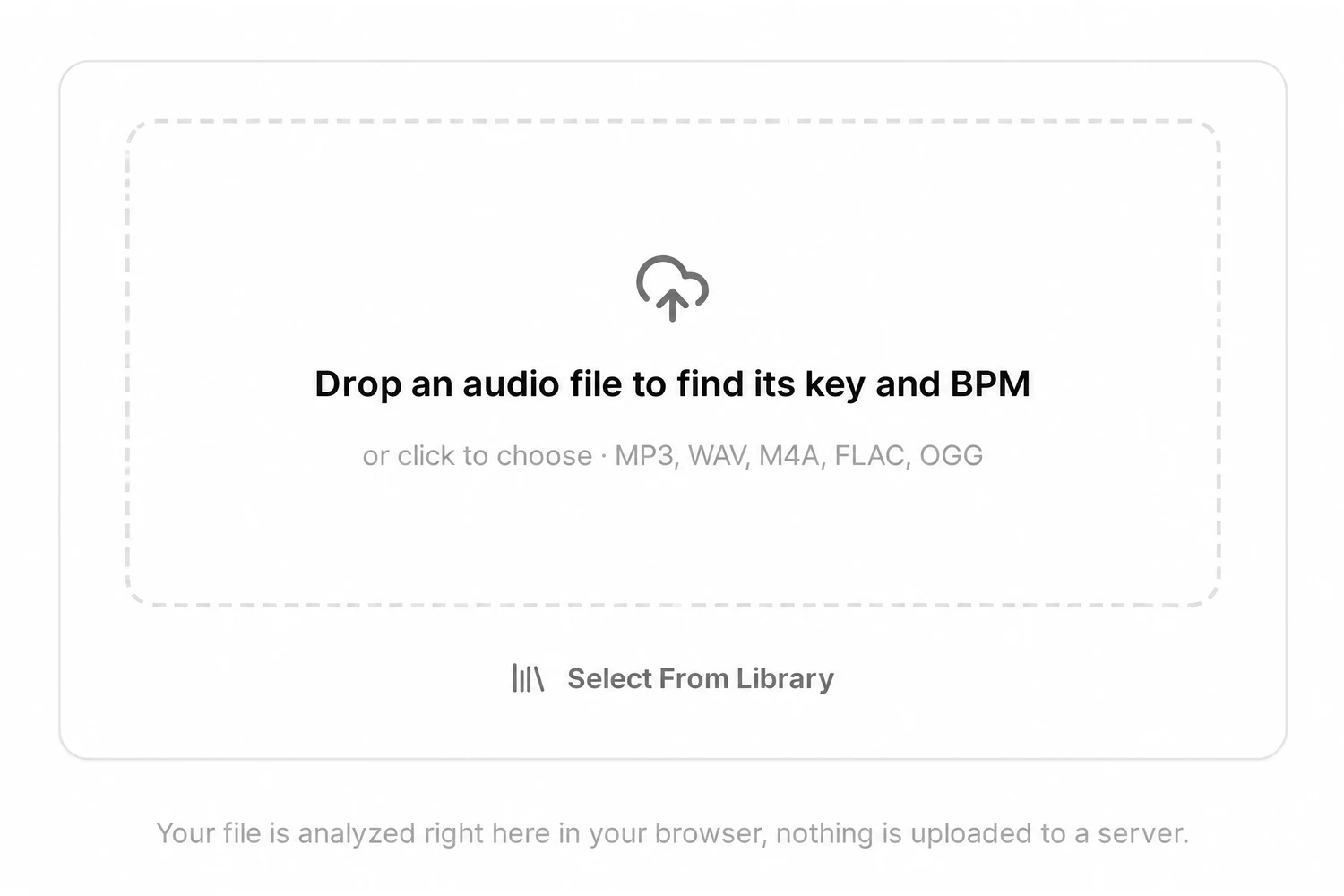
1.Drop the song file on the finder
Drag an audio file onto the box or click to pick one. The key finder analyses it in your browser and does not send the file anywhere.
2.Read the key, then check it by ear
The large letter is the home note and the line under it says major or minor; the Camelot code and the tempo come with it. Play the home chord against the song before you trust it.
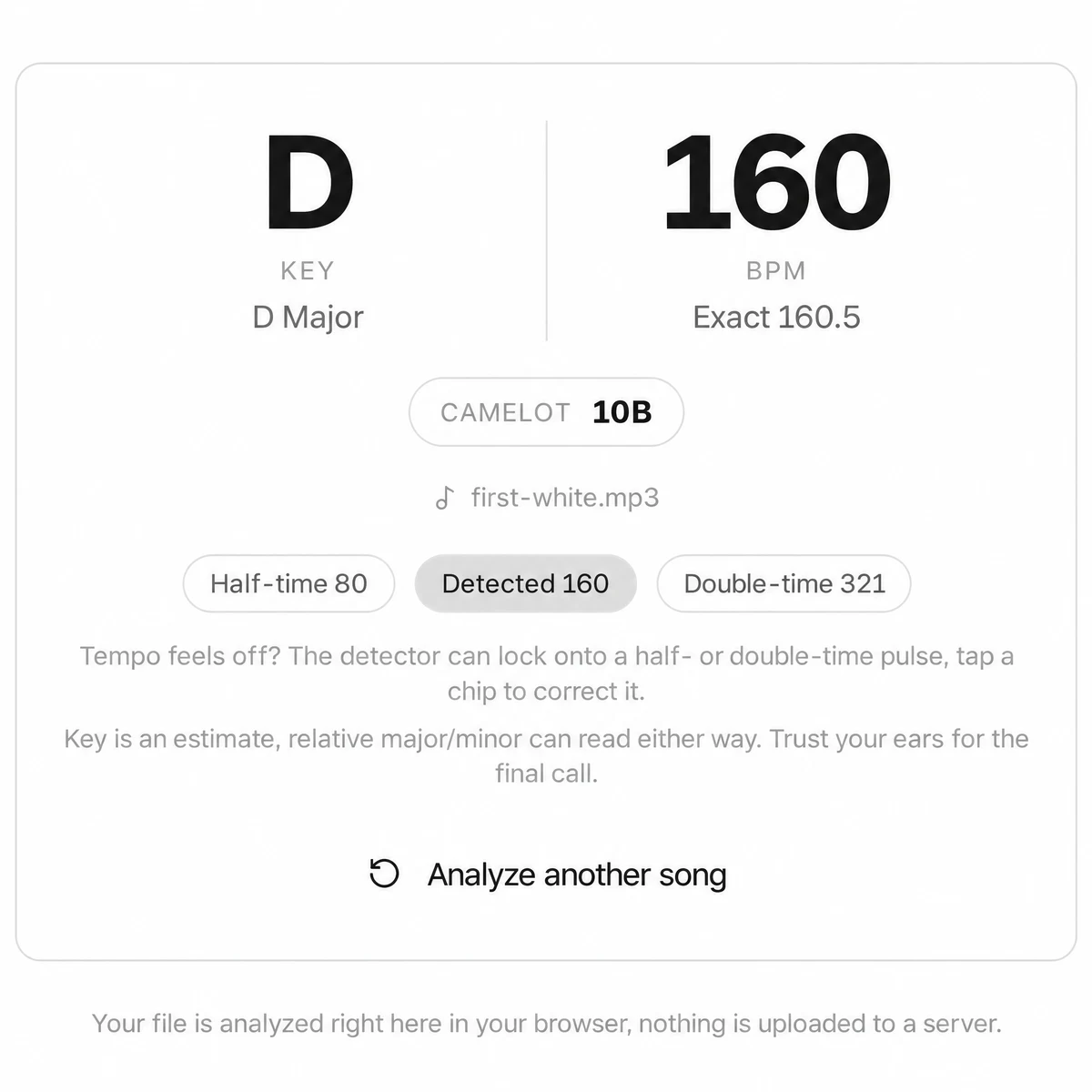
Drop the song file in for a first estimate of the key.
Open the key finderNot sure what a chord is called? In the chord finder’s reverse mode you tap in the notes you hear and it names the chord, on guitar, piano or ukulele.
Name a chord from its notes, then look it up in the family table.
Open the chord finderWhen the key is hard to pin down
Six situations where the four steps need one more thought.
- The song changes key. A last chorus pushed up a step is the classic case. Find the key of each section on its own; a detector gives one answer for the whole file.
- Chords borrowed from outside the key. A D major chord in a song in E, or an F in a song in C, is color, not a new key. If the home chord and most of the chords still fit, the key stands.
- Blues and rock riffs. Songs built on three dominant seventh chords, such as E7 A7 B7, fit no single major scale. Name the key after the home chord: E.
- Modal songs. A song that keeps resting on a minor chord but uses a major sixth, or on a major chord with a flat seventh, is in a mode such as Dorian or Mixolydian. Name the home note first; the mode is the detail.
- A capo on the guitar. A chord chart in G shapes with a capo on fret 2 sounds in A. The key is what you hear, not the shapes on the page.
- No chords at all. For a vocal alone or a single line melody, use the note the tune keeps landing on, especially at the end of phrases.
Questions about song keys
What does the key of a song mean?
It names the note that feels like home and the scale the song is built on. A song in G major keeps returning to G and uses mostly the notes G A B C D E F#.
Is the first chord always the key?
Often, but not always. Many songs open on the IV or the vi chord. The last chord, and the chord the chorus resolves to, are better clues than the first.
What is the difference between a major and a minor key?
Where the song comes to rest. In a major key that resting chord is major, and the mood usually leans bright; in a minor key it is minor and the mood leans darker. A major key and its relative minor use exactly the same seven notes.
How do I find the key of a song I wrote?
List your chords and run them through the four steps above. If you have a recording, a key finder gives you a first guess to check against those chords.
Can a song be in two keys?
One section at a time, yes: songs modulate, most often up a half or whole step for a last chorus. Each section has its own key.
Why does a key finder give me the relative minor?
C major and A minor use the same seven notes, so from the notes alone they look alike. Which one is right depends on the home chord, which you can hear.